There’s a reason a crystal chandelier stops people in their tracks. Where an ordinary light simply illuminates, a crystal fixture seems to come alive — throwing points of brilliant light across the walls, scattering rainbows, and shifting as you move around it. This isn’t decoration for its own sake; it’s physics at work.
The sparkle of a crystal chandelier is the visible result of how crystal bends, splits, and bounces light, and understanding the science behind it makes the effect even more remarkable.
Light and the Nature of Crystal
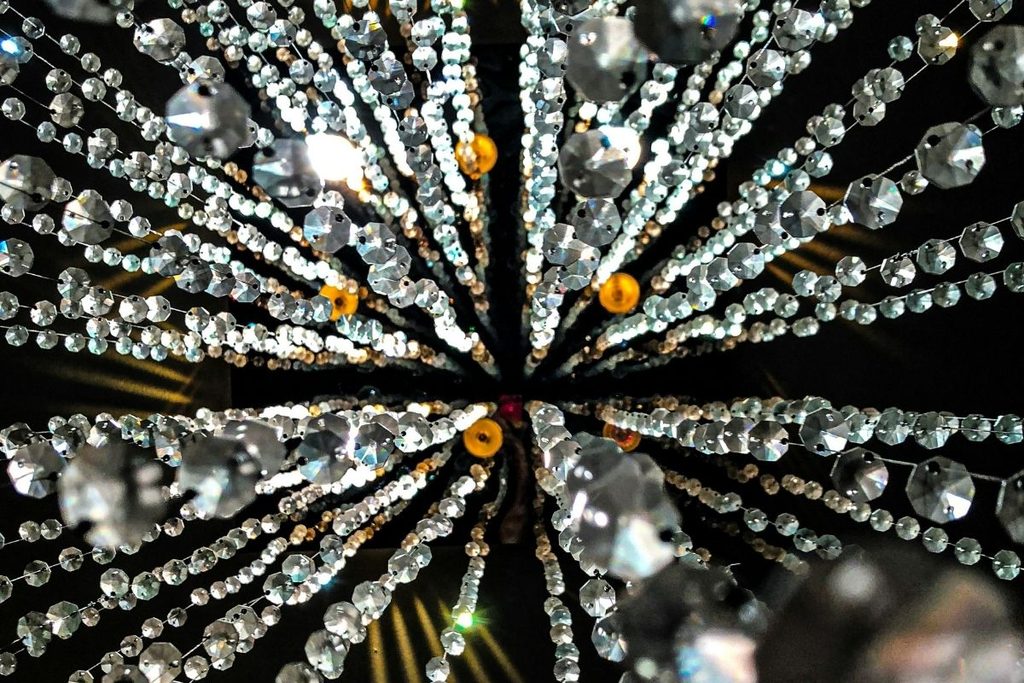
To understand why crystal sparkles, it helps to start with what happens when light meets a transparent material. Light travels in waves, and when it passes from one medium into another — from air into crystal, for instance — it changes speed. This change in speed causes the light to bend, a phenomenon called refraction. The denser and more optically refined the material, the more dramatically it bends the light passing through it.
Crystal, especially high-quality optical or lead, has a high refractive index, meaning it bends light strongly. This is the foundation of everything a crystal chandelier does. Where ordinary glass bends light modestly, fine crystal bends it sharply, setting the stage for the brilliant optical effects that follow.
Refraction: Bending the Light
When light enters a cut crystal, it doesn’t pass straight through. The angled facets — the precisely cut flat surfaces — cause the light to bend as it enters, travel through the crystal’s interior, and bend again as it exits. Each facet acts like a tiny lens, redirecting light in a specific direction. A single crystal with many facets sends light off at many angles at once, which is why just one can cast multiple points of light.
The quality of the cut matters enormously here. Precisely cut facets with sharp, clean edges refract light cleanly and predictably, producing crisp, brilliant sparkle. Poorly cut or molded surfaces scatter light more diffusely, giving a softer, duller shine. This is a large part of why finely cut crystal outperforms cheaper glass — the geometry of the cut is doing precise optical work.
Dispersion: Splitting Light Into Color
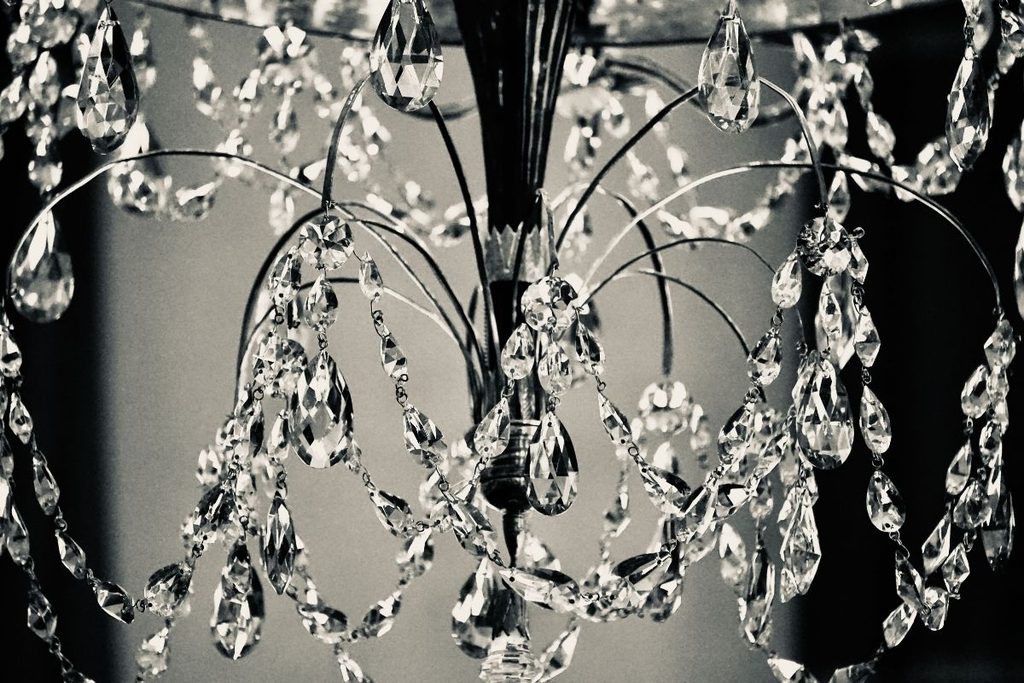
The rainbows a crystal chandelier throws are the result of dispersion, one of the most beautiful optical effects crystal produces. White light, though it appears colorless, is actually made up of all the colors of the spectrum. Different colors have slightly different wavelengths, and when white light refracts through crystal, each color bends by a slightly different amount.
The result is that white light entering emerges separated into its component colors — the same effect that produces a rainbow when sunlight passes through raindrops, and that Isaac Newton famously demonstrated with a glass prism. A well-cut crystal acts as a prism, splitting light into flashes of red, orange, yellow, green, blue, and violet that dance across the room. A high-quality one with a high refractive index disperses light more strongly, producing more vivid color, which is why premium crystal seems to throw richer rainbows than ordinary glass.
Reflection: Bouncing Light Around
Alongside refraction and dispersion, reflection plays a major role in a chandelier’s sparkle. Some light striking a crystal facet doesn’t pass through but bounces off the surface, and light traveling inside the crystal can reflect off interior facets before exiting. These internal reflections send light ricocheting through, multiplying the points of brightness and adding to the overall brilliance.
In a chandelier with many crystals, this effect compounds. Light bounces not only within each one but between neighboring crystals, each one catching and re-scattering light from the others. The whole fixture becomes a complex web of refracted, dispersed, and reflected light, which is why a full crystal chandelier produces so much more sparkle than the sum of its individual pieces.
Why Movement Amplifies the Effect
Part of a crystal chandelier’s magic is that it never looks quite the same twice. As you move around the room, or as the crystals sway slightly in a draft, the angles between the light source, the crystals, and your eye constantly shift. Because each facet sends light in a specific direction, changing your viewpoint changes which flashes of light and color you see. The chandelier seems to shimmer and come alive, a dynamic effect impossible with a static, non-refractive light.
This is also why the arrangement and quantity of crystals matter to a design. More crystals, cut and positioned to catch light from many angles, create a richer, more animated display. The best crystal chandeliers are engineered so that light interacts with as many facets as possible, maximizing the interplay of refraction, dispersion, and reflection.
From Science to Selection
Understanding the science explains what to look for in a crystal chandelier. High refractive quality, precise faceting, and good clarity are the properties that produce brilliant sparkle and vivid rainbows, and they’re exactly what distinguish fine crystal from ordinary glass. A fixture designed to let light strike many well-cut facets will always outperform one where the crystal is an afterthought. Those drawn to this interplay of light can find chandeliers that showcase this effect to particularly brilliant result, their cut and arrangement engineered to maximize the play of light.
Light Made Visible
A crystal chandelier is, in the end, a device for making the behavior of light visible. Refraction bends it, dispersion splits it into color, and reflection scatters it into countless points of brilliance — all happening at once, across every facet of every crystal. What looks like pure decoration is really an elegant demonstration of optics, and knowing the science behind the sparkle only deepens the wonder of watching a crystal chandelier fill a room with light.
Images attributed to Unsplash.com and Pexels.com.