Most people who buy a projector imagine a room that changes. They picture dinner, then a film, then a room that goes back to being a room again. What they get instead is a projector that lives on a shelf in the open, a screen that stays down because putting it away is effort, and a set of cables that everyone has agreed to ignore. The room did not transform. It just acquired equipment.
The households that get the version they imagined usually have one thing in common: the projector has a home that was designed for it. A CINÈST ust projector console is built around that idea, and the difference shows up in the ordinary rhythm of a week rather than in a specification table. This is what that rhythm actually looks like once the furniture is doing its share of the work.
Morning: the room belongs to the room
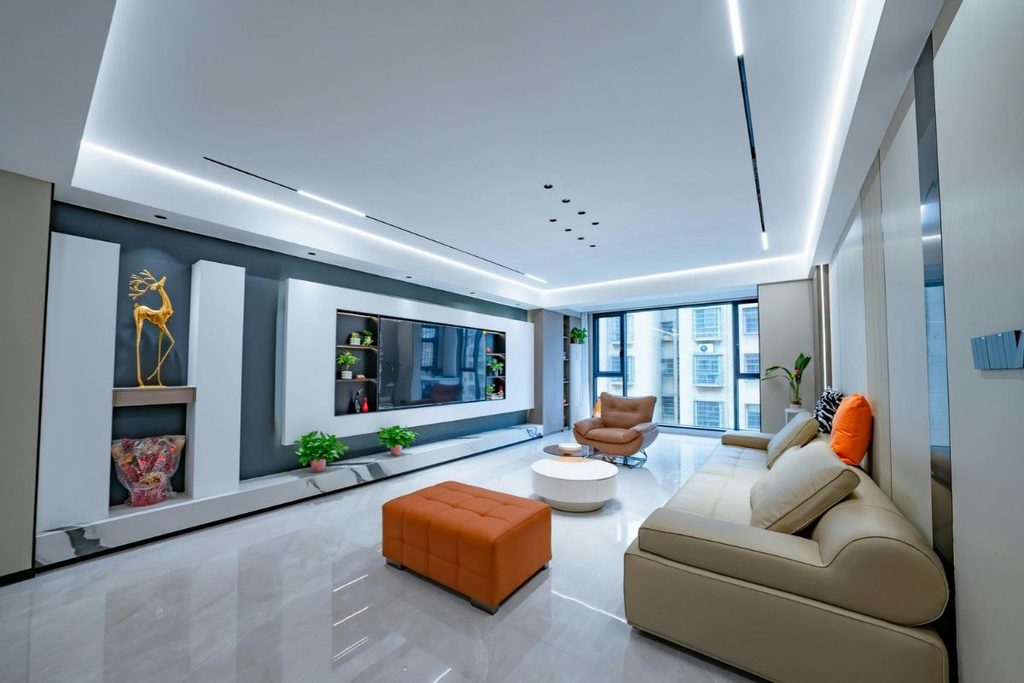
The first thing you notice is not what happens when you watch something. It is what the room looks like when you do not. With the projector hidden behind closed panels and the screen out of the way, the cabinet reads as furniture. It holds the things a media cabinet is supposed to hold, the surface stays usable, and nothing about the room announces that there is a cinema hiding in it.
That matters more than it sounds. Most people do not live in a dedicated theater room. They live in a space that has to host a Tuesday morning, a homework session and a Saturday night, and furniture that only works in one of those modes ends up making the others worse. A console that closes is the difference between adding a hobby to your living room and taking it over. The surface stays clear for a laptop, the doors close on the remotes and the games, and nobody has to explain why there is a lens pointing at the wall during breakfast.
A piece of furniture that opens and closes every day has to be built for that rhythm. The panels on a console like this run through their cycle tens of thousands of times in testing before one ships, because a mechanism that works in the first week and drifts by the sixth month is worse than no mechanism at all. The cabinet itself is FSC-certified wood finished with water-based coatings, which is partly about the air in a room you sit in for three hours at a stretch, and partly about a surface that still looks like furniture after a year of being opened, closed, leaned on and wiped down.
After dinner: one press, not a ritual
The second change is how little effort a film takes. The sequence that kills projector setups is not complicated, it is just tedious: open the doors, shove the projector into roughly the right place, remember which remote does what, fix the geometry, find the input, start the film. Do that a few times and the projector becomes a weekend event rather than a Tuesday habit.
Remove the sequence and behavior changes. The panels open, the projector is already where it was set, the geometry is the geometry from last time, and the film starts. Some setups let the projector remote drive all of it, so the cabinet follows the projector rather than the other way round. The technical phrase for this is position memory, and the practical effect is that watching something becomes a decision rather than a project. Guests notice it immediately, because there is nothing to explain and nothing to wait for. You ask whether anyone feels like a film, and the film starts. That immediacy is what turns a projector from an occasion into a habit, and habits are what justify the money spent on a big picture in the first place.
The cooling behaves the same way, which is to say invisibly. Fans come on when the cabinet warms past a set temperature and stop when it cools down, staying below the level where you would notice them. Nothing asks for attention during the film, and nothing has to be opened or propped or adjusted halfway through.
The rest of the week: everything has a place
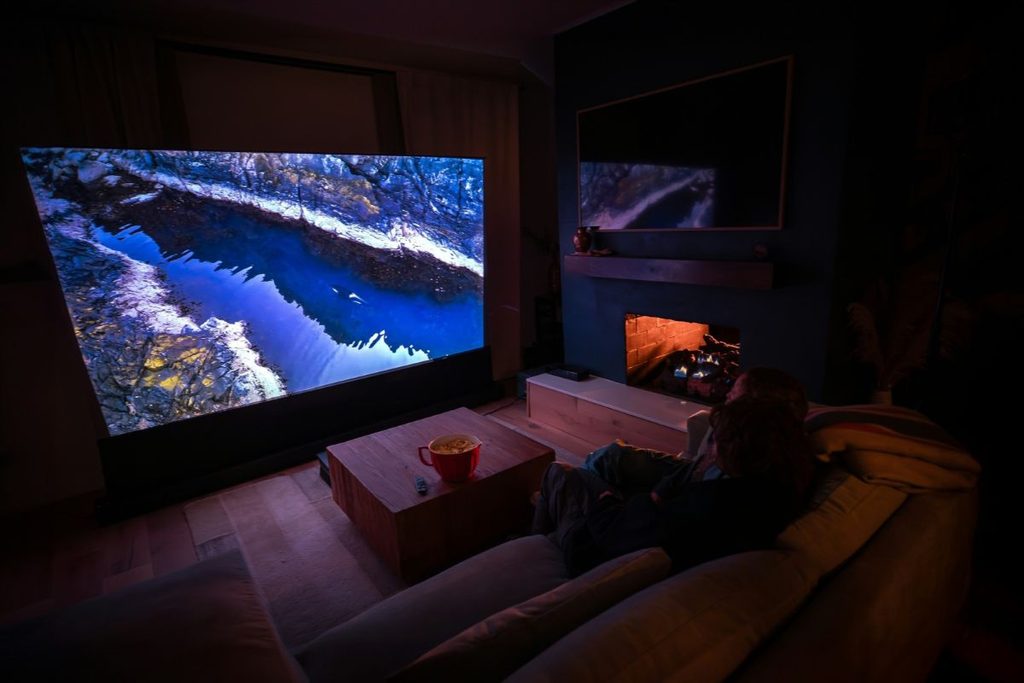
The third change is the least glamorous and probably the most valued. A household with a projector usually also has a receiver, a console, a streaming box, a soundbar and a tangle of HDMI leads. In a lot of living rooms those live in a pile behind the television and the pile is the reason the room never feels finished.
Put them in a cabinet designed for them and the pile disappears into shelves that can be reconfigured, with power outlets inside so nothing has to run to the wall and a back panel that comes off when something needs rewiring. Cables route through the structure. The soundbar still sounds like a soundbar because the doors in front of it are fabric rather than wood. When friends come over, there is nothing to tidy, because there is nothing out. The small cleanup that usually follows a movie night, the coils of cable behind the television, the remote that always goes missing, simply stops being part of the evening.
With kids and pets in the house
Anyone who has watched a toddler head toward a projector lens will understand why this belongs in the same article. Equipment at floor level is equipment at toddler level, and a lens is expensive to replace.
A console that closes solves it without a separate conversation, and the details make it safe to live with: panels that stop the moment they meet resistance, so nothing gets trapped, and a physical button that resets the cabinet if it ever behaves oddly. The projector is protected from dust and from curious hands at the same time, which means it can stay in the living room rather than being moved somewhere nobody goes.
A year in, and nothing has drifted
The real test of a projector setup is not the first weekend, it is the fortieth. Alignment is the thing that usually goes first. A projector nudged by a duster, a cabinet bumped by a vacuum cleaner, and the picture that was perfect in October is crooked by March, with a corner of the image climbing the wall. A console that remembers its position removes that failure mode, because the projector returns to the same coordinates every time rather than to roughly where it was left. The picture that was set up once is the picture that is still there a year later, and when the projector is finally replaced with a newer model, the cabinet does not need replacing with it. Any ultra short throw projector, kept at its best, is the whole idea: the furniture takes responsibility for geometry, power and cooling so the projector is free to be a projector.
Weekends: the room earns its keep

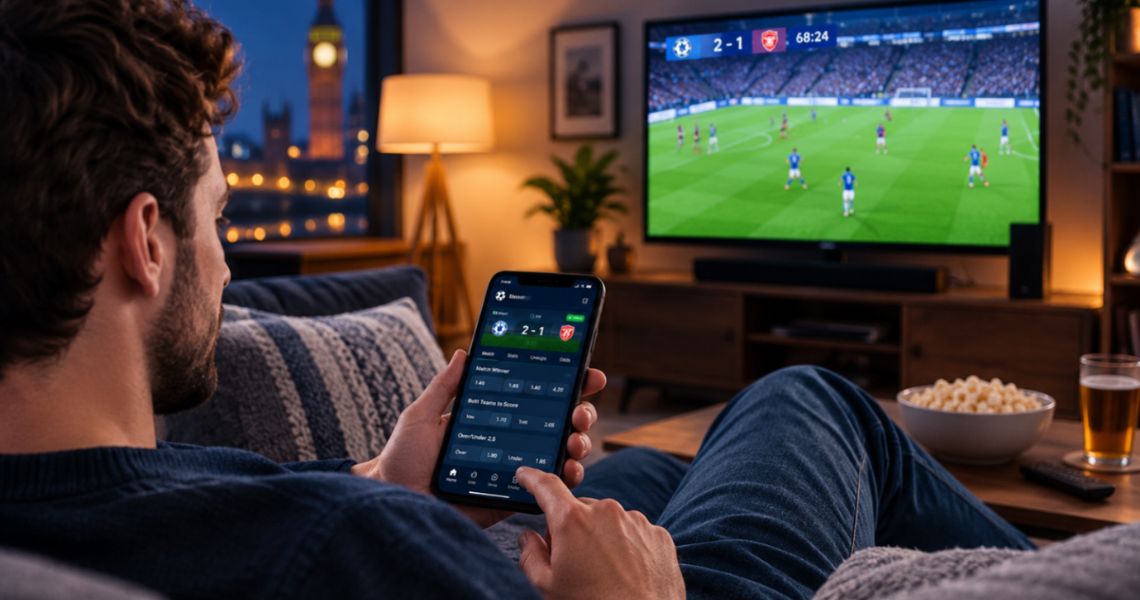
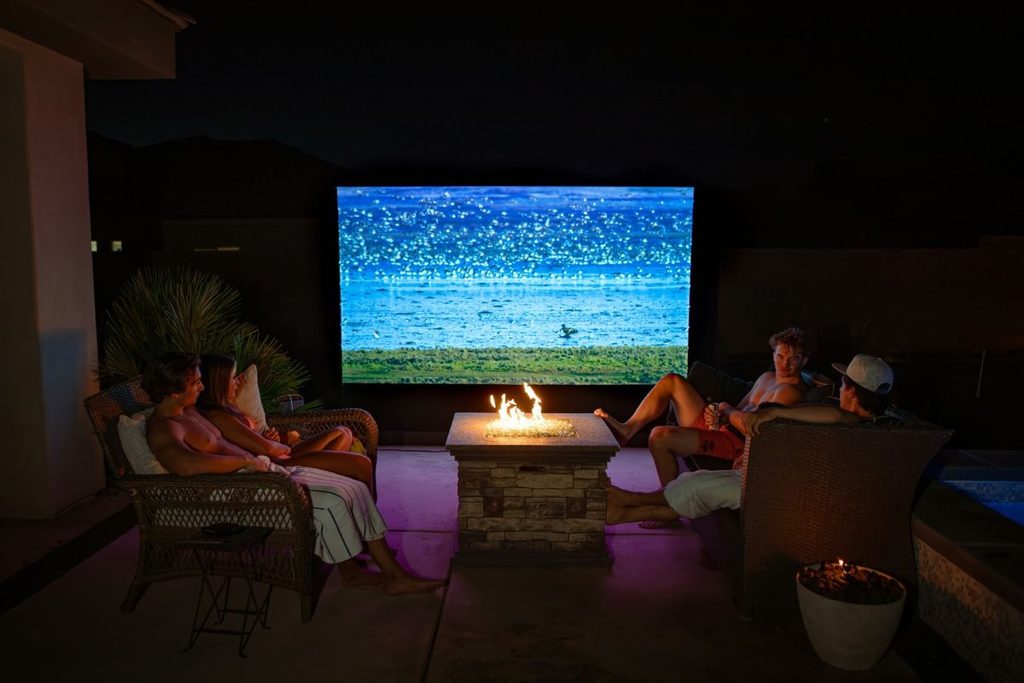
The last change is that the room starts getting used for the things people bought a projector for in the first place. A big screen is not only for films. It is for a match with six people on the sofa, for a games console that suddenly feels different at a hundred inches, for the kids’ film that runs while dinner is cleared.
None of those moments are special occasions, and that is the point. The households who get value from a projector are not the ones with the most expensive lens, they are the ones who use it on a Wednesday because using it costs nothing. That is the version of home cinema that survives contact with real life, and it is almost never about the projector. It is about whether the room can switch modes without a fight. A console designed for ultra-short-throw handles the switching: the projector appears when it is wanted, disappears when it is not, stays aligned without being asked, and keeps its cool through a long film. The rest of the room gets to stay a room.
Images courtesy of unsplash.com, Freepix.com and pexels.com. Feature image supplied