Most conversations about gemstone rings begin at the top of the ring, where a raised center stone does all the talking. A wedding band begins somewhere else entirely. It is a closed circle that has to rest against skin all day, clear a knuckle, live beside whatever else is already on the hand, and still read as a deliberate object rather than a plain strip of metal.
That is a genuinely different design problem, and it explains why moss agate wedding bands behave so unlike a moss agate solitaire. The stone stops being a focal point mounted on a stage and becomes part of the band’s own surface. Everything downstream of that – how the material is cut, how deep the seat sits, how wide the metal runs – follows from that single shift.
A band asks different things of a stone than a solitaire does
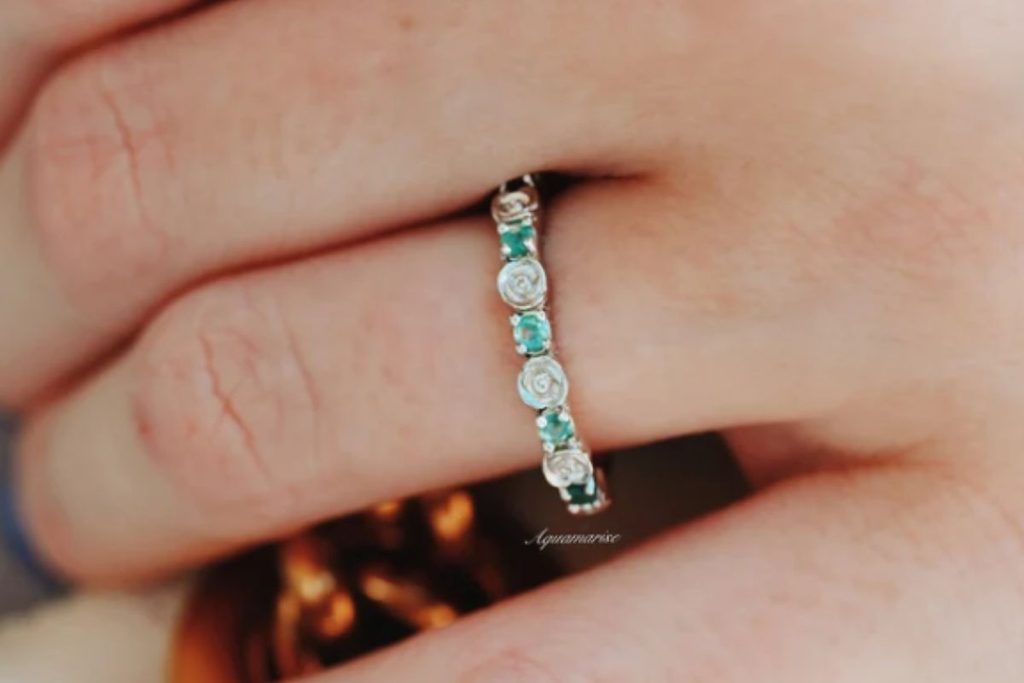
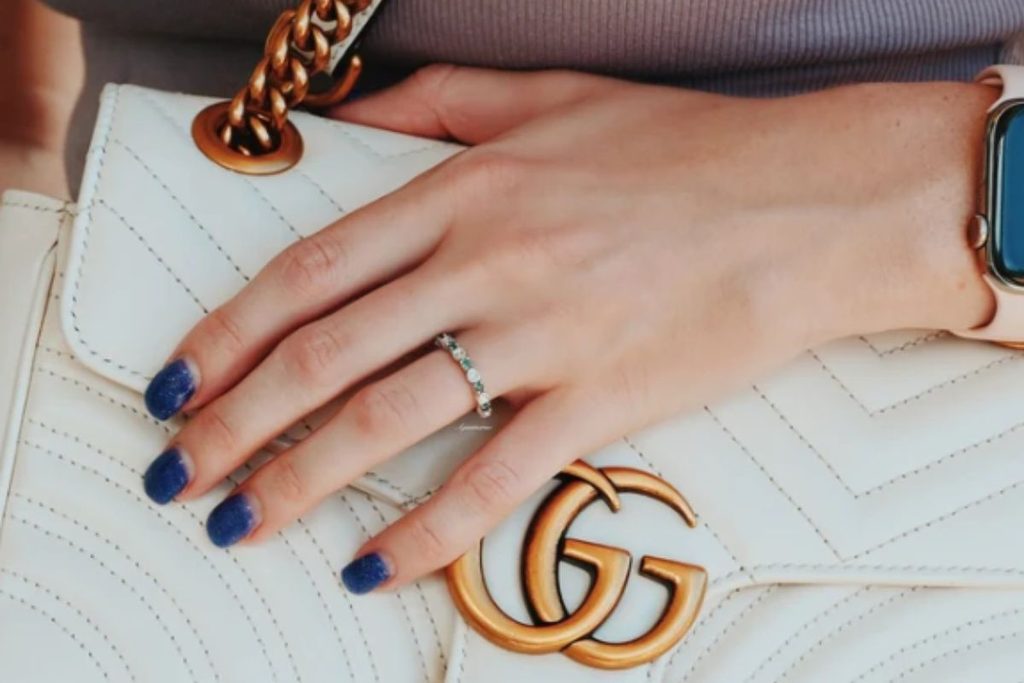
A solitaire gives a stone height, light from underneath, and permission to be the only event on the finger. A band gives it none of those things. The stone has to hold up while sitting level with the metal, lit mostly from above, and viewed at an angle most of the time, because that is simply how a hand is seen by other people. In practice this rules out a great deal of gem behaviour. Brilliance that depends on light entering a pavilion and bouncing back out is largely wasted in a low setting. What survives at band height is pattern, colour, and surface quality. Moss agate is almost entirely pattern, colour, and surface, which is exactly why it translates into band work better than most transparent stones do.
There is a second, more practical difference. A band is often the ring that is never taken off, so it lives under a hard structural constraint: nothing should protrude far enough to catch on fabric or a pocket. A tall setting on a band is a snag waiting to happen. Designers answer that by dropping the material into the metal rather than lifting it out, which is where inlay, channel work, and flush seats enter the picture.
What the green pattern actually is
Moss agate is a chalcedony, which makes it a member of the quartz family, and it sits at roughly 6.5 to 7 on the Mohs scale. The branching green figures inside it are the reason anyone looks twice, and they are almost universally described incorrectly. They are not fossilized moss, plant matter, or anything organic at all. They are mineral inclusions, usually iron or manganese oxide, that formed in dendritic branching structures while the chalcedony crystallized around them. The resemblance to lichen, ferns, or a distant treeline is coincidence, produced by the same branching growth mathematics that shows up in frost spreading across a window. Educational material on stone selection, including the reference pages at Aquamarise.com, tends to lead with this distinction, and it matters for wedding bands designed in a specific way: because the pattern is internal rather than painted on the surface, a cutter can orient a slice so the densest branching lands where the band will actually be seen.
The other structural fact worth holding onto is that moss agate is translucent rather than transparent. Light travels into it and diffuses instead of passing cleanly through. That is why it is cut as a cabochon or a flat slice rather than faceted like a diamond, and why it looks best in a seat that still lets a little light reach it from the side.
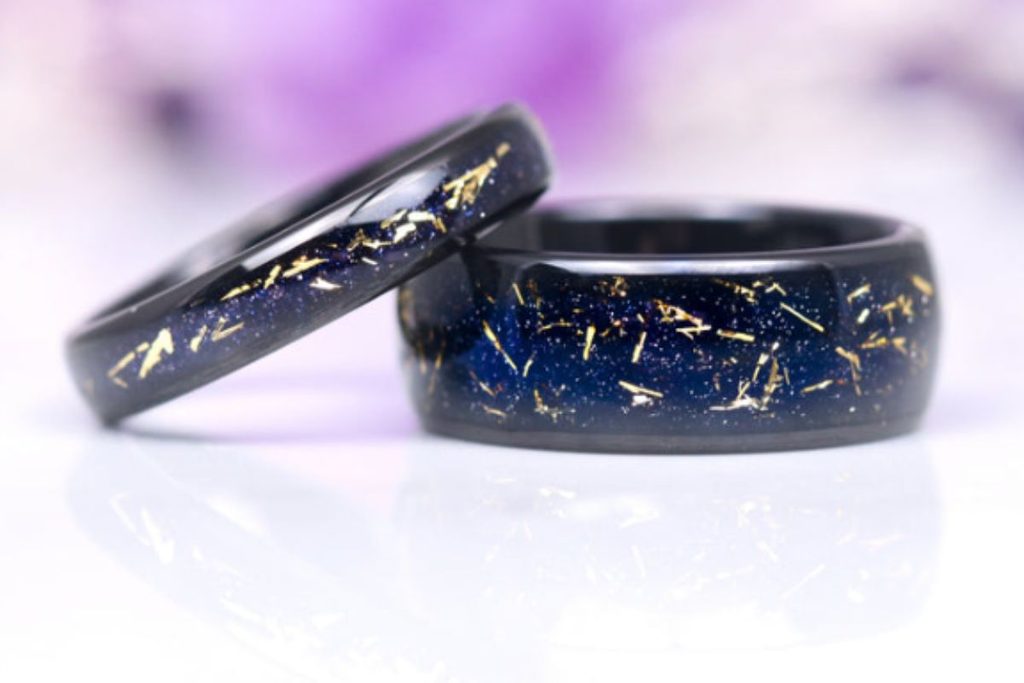
Inlay and channel work: material set into the metal, not on top of it
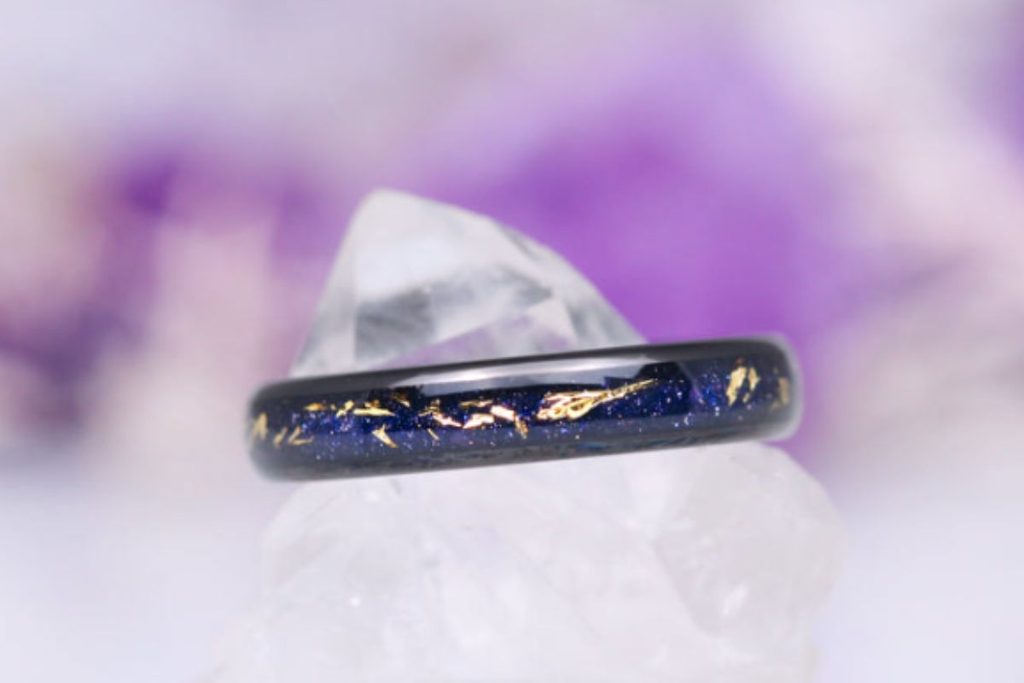
Inlay is the oldest answer to the low-profile problem. A groove is cut into the band, a shaped piece of stone is fitted into it, and the whole surface is brought level so the finished ring reads as one continuous form. Done well, the stone feels like part of the metal rather than a passenger riding on it. Inlay suits moss agate particularly well because the material does not need height to perform. A flat, well-polished plane of translucent green shows the dendrites clearly and shows them across the full length of the channel, which is more of the pattern than a small cabochon could ever display.
Channel setting is the close relative. Instead of a continuous ribbon of stone, shaped segments sit between two raised metal walls that protect the edges. The walls do real work here. Agate is tough for its class but it has no cleavage planes to rely on and no great love of a sharp impact on an exposed corner, so a rail of metal on either side is genuine engineering, not decoration. When you see a band where the green appears to run in a clean line with a fine bright edge on each side, that is usually what you are looking at.
A third approach worth knowing is the partial inlay, where stone occupies only an arc of the circumference and the rest of the band is solid metal. It gives the pattern a defined beginning and end, which some people prefer to a stone that wraps the whole finger, and it leaves a comfortable stretch of plain metal against the palm side.
Twig and botanical bands, where the pattern echoes the metal texture
The twig band is the design where moss agate stops being a stone in a setting and starts being part of a single idea. A twig band is cast or carved so the metal itself takes on bark texture, small nodes, and an irregular organic silhouette rather than a machined circle. Set a dendritic stone into that and the two languages rhyme: branching inside the material, branching in the metal around it. It is one of the few pairings in jewellery where the stone and the mounting are describing the same phenomenon.
Botanical bands widen the same idea into leaves, vines, and carved foliage. The important craft consideration is restraint. When both the metal and the stone are busy, the eye has nowhere to rest and the ring turns into visual noise. The versions that work usually keep one element quiet. Either the metal is heavily textured and the stone is chosen for a calmer, more open pattern, or the metal stays relatively smooth and lets a dense, dramatic slice of dendrites carry the drama alone.
Twig wedding bands put branching metal texture next to branching mineral inclusions, so the stone and the mounting describe the same shape.
Why low-profile moss agate wedding bands stack cleanly
Stacking is the practical reason low profiles matter so much. Two rings sitting flush against each other only work if neither one has a raised element pushing the other away or scraping it on every hand movement. A flat or gently domed band with the material set level will sit against a neighbouring ring along its whole edge, which looks intentional and keeps both rings from rotating.
A few things separate a band that stacks well from one that does not:
- A flat or slightly rounded outer surface with no prongs or raised bezel edges reaching sideways.
- Consistent width around the full circle, so the two rings meet evenly instead of gapping at one point.
- An inner edge that is softened rather than left square, which matters when several rings share one finger.
- A pattern that still reads when partly covered, since stacked rings inevitably hide some of each other.
That last point is the one people miss. If a stone’s entire appeal lives in a single dramatic feature at one spot on the circle, a neighbouring ring can easily sit right on top of it. Patterns that repeat and spread across the whole band survive stacking far better, which is one reason moss agate wedding bands in continuous inlay tend to work harder in a stack than single-cabochon designs do.
How metal colour changes the way the green reads
Because moss agate is translucent, the metal behind and beside it is part of the finished colour. A white metal surround keeps the green cool and slightly grey, and it sharpens the contrast between the dendrites and the clear body of the chalcedony. Yellow tones warm the whole stone and push it toward olive and moss, which usually makes the pattern feel softer and more atmospheric. Rose tones do something less obvious: pink sits opposite green on the colour wheel, so a rose surround makes the green look noticeably greener by contrast, and it flatters the browner, more rust-coloured inclusions that appear when iron oxide dominates.
None of these is correct or incorrect. They are three different results from the same material, and it is worth looking at the same pattern against all three before deciding what you actually want, because the difference is larger in person than photographs usually suggest.
Hardness, structure, and honest expectations
At 6.5 to 7 on the Mohs scale, moss agate is harder than most people assume and softer than the stones normally chosen for daily wear at the very top of the scale. Chalcedony has a fine microcrystalline structure, which gives it good toughness against impact compared to gems with strong cleavage. What it will not resist forever is abrasion. Household dust contains quartz, and quartz is right around the same hardness, so a highly polished surface on any ring worn constantly will gradually pick up fine surface marks over years. This is why the low, protected setting styles are not just an aesthetic preference for a band. A recessed inlay is shielded on both sides by metal that stands slightly proud of the stone and absorbs most of the contact.
Sensible habits do the rest. Rings come off for weight training, gardening, and anything involving grit or harsh chemistry. That advice applies to nearly every gemstone band, not just this one.
Choosing a pattern rather than choosing a grade
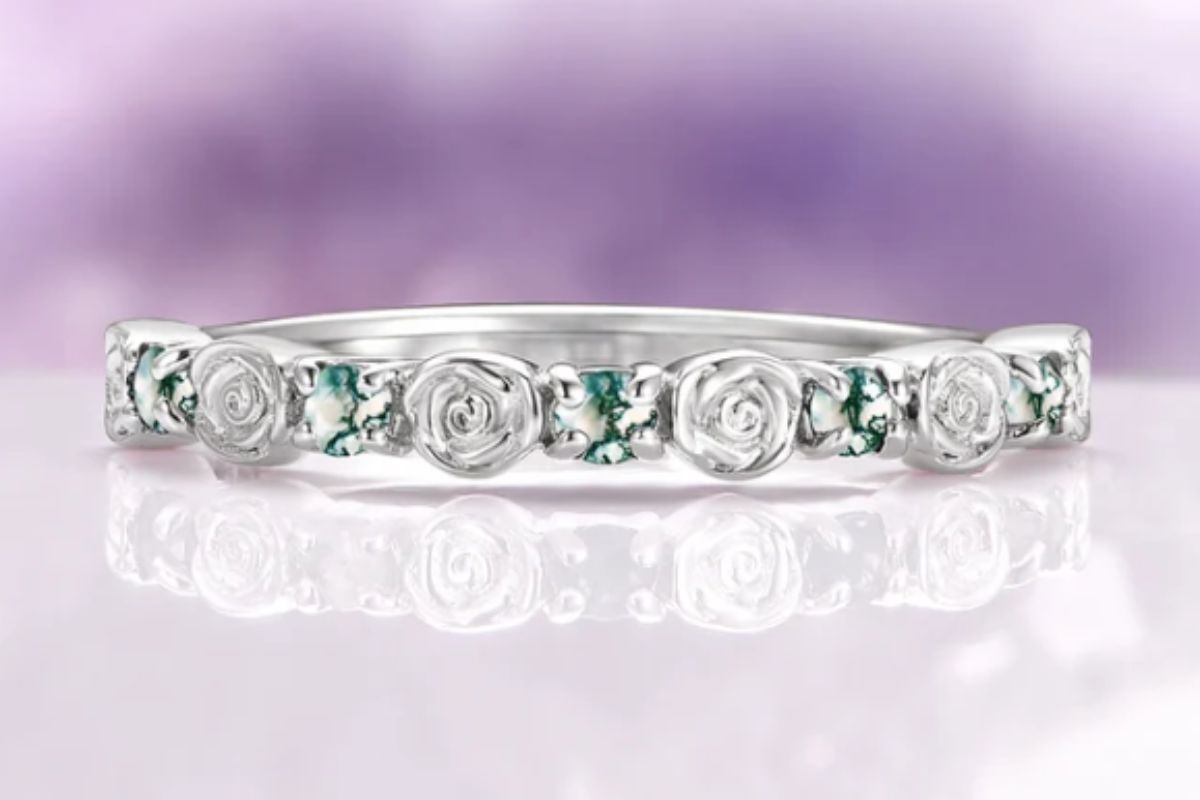
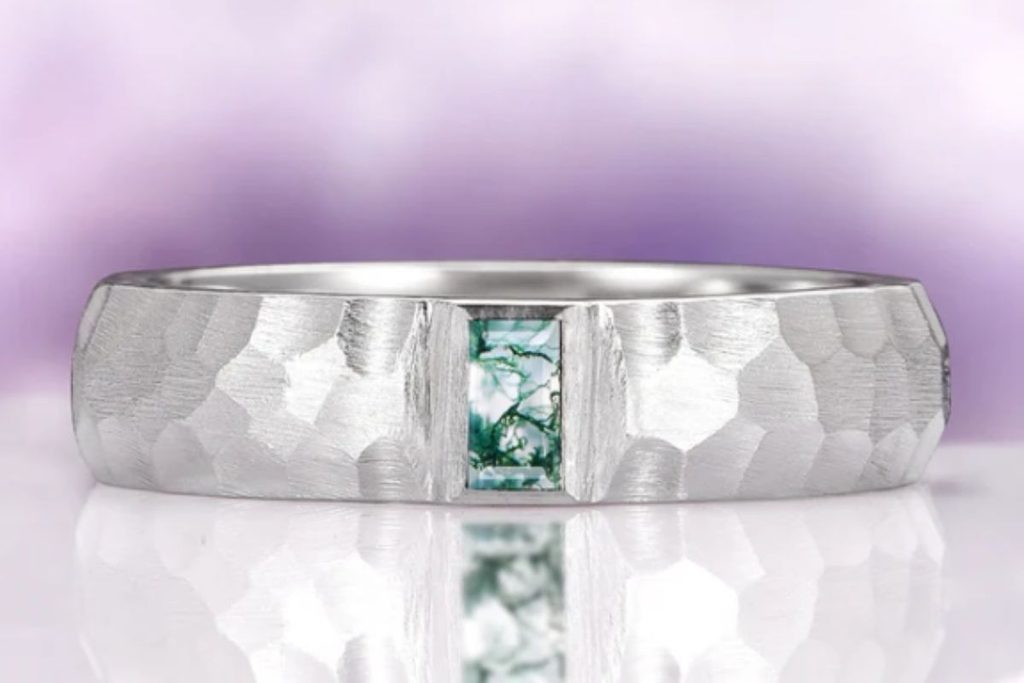
The unusual thing about evaluating this material with an informed eye is that there is no accepted grading ladder to hide behind. No two slices are alike, so the decision is aesthetic rather than technical. People who spend time comparing options usually find themselves sorting by a handful of qualities: how dense the dendrites are, whether the branching is fine and feathery or bold and trunk-like, how clear the surrounding body is, and whether the greens lean cool and blue or warm and brown. Broad selections such as the range of moss agate wedding bands are useful mainly because seeing many patterns side by side is what teaches the eye what it prefers.
Provenance is the last piece. Montana is the best known source and its material has a strong reputation among collectors, while India, Brazil, Uruguay, and Indonesia also produce significant quantities with their own characteristic looks. It is also worth knowing the neighbour: tree agate is opaque and white-bodied, while moss agate is translucent. That single distinction, translucency, is the real difference between the two, and it is what allows light to reach the dendrites at all.
The takeaway
A moss agate wedding band is not a smaller version of a statement ring. It is a different object with different rules, and the design decisions that matter most are the quiet ones: how low the material sits, how the metal protects its edges, whether the pattern spreads across the circle or clusters in one place, and how the metal colour shifts the green. Get those right and you end up with a band that reads as a single considered form rather than a stone glued onto a circle. And because the dendritic pattern inside every piece formed once, in one specific set of conditions, and will never be repeated, the finished ring carries something no grading report can express.
Images supplied