Sponsored Content: This article discusses SHR Miner and its cloud computing-power services.
XRP holders have endured a painful reversal. After reaching approximately $3.65 at its previous peak, the XRP price has fallen nearly 71%, leaving many investors who entered at higher prices facing substantial unrealized losses.
The bigger frustration is what comes next. Selling now could lock in a major loss, while continuing to hold generates no additional cash flow if XRP remains weak. For holders who have already spent months waiting, that creates a practical question:
If I don’t want to sell my XRP, does the rest of my crypto capital have to remain idle too?
Key Takeaways
- XRP remains nearly 71% below its previous peak, leaving many long-term holders facing significant unrealized losses.
- SHR Miner allows crypto holders to rent AI-assisted cloud computing power rather than purchase and operate mining hardware.
- Users can choose defined rental periods, monitor daily output and manage the entire process online.
- SHR Miner says its global infrastructure serves more than 5 million users across 180+ countries and regions.
That is where SHR Miner offers another option.
SHR Miner Brings AI Cloud Computing Power to Crypto Holders
Founded in 2018 and headquartered in the United Kingdom, SHR Miner says it has expanded its infrastructure to more than 150 data centers, serving over 5 million users across 180+ countries and regions. Published platform materials describe a fully cloud-based service designed to make computing-power rental accessible without requiring users to own or operate mining equipment.
SHR Miner is not an XRP investment product, and XRP itself is not mined.
Its core model is cloud computing-power rental.
Users choose a defined computing-power contract, while SHR Miner manages the underlying hardware, electricity, cooling, maintenance and computing infrastructure.
For users, the model is straightforward:
- Zero technical barrier: no mining hardware or specialist background required.
- Defined rental period: users know how long the computing-power contract operates.
- Daily settlement: contract output can be monitored through the dashboard.
- 100% cloud access: mining activity and output can be viewed remotely through the platform.
- Multi-asset access: published materials list BTC, ETH, DOGE, USDT, USDC, XRP, SOL, LTC and BCH among supported digital assets.
Instead of requiring XRP’s price to recover before their broader portfolio becomes productive, users gain another potential use for part of their digital assets.
How AI Is Changing Cloud Computing Power
SHR Miner positions its infrastructure around AI-assisted computing management and intelligent hashrate scheduling.
Rather than relying entirely on manual mining operations, its AI systems are designed to coordinate computing clusters, dynamically allocate computing resources, monitor infrastructure and optimize workloads and energy use. According to published SHR Miner materials, this intelligent scheduling is intended to direct computing capacity more efficiently and improve overall output efficiency.
For users, that means less complexity:
- AI-powered hashrate scheduling
- Automated infrastructure monitoring
- Computing-power optimization
- Energy-efficiency management
The significance goes beyond mining.
The previous crypto cycle focused heavily on owning digital assets. The AI era is increasingly focused on computing power, automation and digital infrastructure.
For crypto holders, the shift is increasingly moving from simply owning digital assets to accessing the computing infrastructure that powers the AI economy.
For XRP holders whose assets have spent months waiting for price appreciation, renting computing power offers access to a different part of the digital economy.
Ignoring that shift could mean missing more than another crypto trade — it could mean missing the growing importance of computing infrastructure in the AI era.
How Does SHR Miner Cloud Computing Work?
SHR Miner offers multiple computing-power packages with different rental amounts and durations.
Representative structures can include:
| Contract | Entry Amount | Duration | Daily Reward | Listed Contract Reward |
| MICROBT WhatsMiner M66 | $3,000 | 15 days | $40.50 | $607.50 |
| Bitcoin Miner S21 XP Imm | $5,000 | 25 days | $70.50 | $1,762.5 |
| Bitcoin Miner S21e XP Hyd | $10,000 | 35 days | $151.00 | $5,285 |
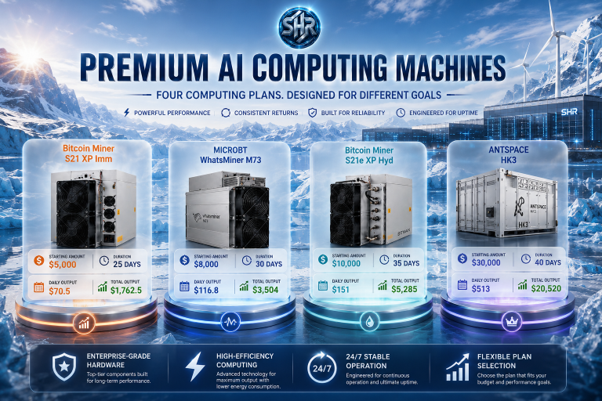
Each contract displays key information including:
Rental amount · Contract period · Daily stated output · Expected total output · Settlement terms
Users can review the latest options directly on the SHR Miner product page.
Waiting for XRP to recover has no fixed timetable.
A computing-power contract does.
How XRP Holders Can Evaluate SHR Miner Security
For experienced crypto users, the most important question is not simply the advertised output.
It is whether the complete process works as expected.
SHR Miner states that its security framework includes McAfee and Cloudflare protection, alongside HSBC-related institutional custody arrangements and Fireblocks cold-wallet technology. Its published promotional materials also state that the platform operates under UK FCA and U.S. MSB registrations. These are platform-stated credentials that users should independently verify as part of their own due diligence.
Moving crypto onto any third-party platform still introduces risk, so a sensible approach is:
Start small → monitor daily settlement → complete the contract → test withdrawal → decide whether to scale
Rather than treating any platform as risk-free, users can verify the complete experience for themselves before making a larger decision.
Michael’s Experience: A High-Value XRP Holder Tests Before Scaling
Michael is an illustrative example of that type of user.
He is a 47-year-old business owner with a six-figure cryptocurrency portfolio, including a substantial XRP position, BTC holdings and a separate stablecoin reserve for liquidity.
After XRP’s sharp decline, Michael did not want to sell a large position at depressed prices. But he also disliked seeing a meaningful amount of crypto capital sitting idle.
Although he had enough capital to begin with a larger computing-power package, Michael first tested SHR Miner with a $500 short-duration computing-power rental.
His objective was not to maximize output. It was to verify:
- Computing-power activation
- Daily settlement
- Contract completion
- Withdrawal
Only after completing the full cycle did he increase his computing-power rental.
Michael’s approach reflects a simple principle for higher-value crypto holders: test the technology, verify settlement and withdrawal, and only then decide whether the computing-power rental deserves a larger allocation.
For the next stage, Michael moved to a $5,000 longer-duration contract, while keeping most of his XRP position untouched.
His portfolio now had two different roles:
XRP remained a long-term digital-asset position.
Rented computing power became a separate source of productive capacity.
Michael was also attracted to the AI side of the model. As a business owner, he had already watched AI transform software, marketing and automation. To him, computing power was increasingly becoming valuable digital infrastructure.
Before using SHR Miner, he mainly opened his crypto portfolio to ask:
“Has XRP recovered?”
After renting computing power, he had another question:
“What did my computing capacity produce today?”
Michael is an illustrative scenario, not a verified customer testimonial or a guarantee of results.
Start Small, Verify the Process, Then Decide
SHR Miner currently promotes a $15 registration bonus for new users, alongside VIP and referral reward programs for users who remain active on the platform. Published materials describe tiered VIP benefits and referral bonuses in addition to standard computing-power contracts.
For new users, the process remains simple:
Register → review contracts → start small → monitor daily settlement → complete one cycle → test withdrawal → decide whether to scale
No hardware setup, mining expertise or local equipment is required, and the process can be monitored entirely through the cloud.
Users can create an SHR Miner account here and review the available computing-power contracts before making a larger decision.
XRP Holders Have Already Spent Enough Time Waiting
For many XRP holders, selling after a major decline is unattractive.
But allowing crypto capital to remain idle for another six or twelve months may be equally frustrating.
SHR Miner offers a third option:
keep the XRP exposure you still want while using part of your available digital assets to rent AI-assisted cloud computing power for a defined period.
No mining hardware.
No technical setup.
Daily settlement and cloud-based monitoring.
And no need for the entire portfolio to depend on XRP returning to its previous highs.
Crypto introduced millions of users to digital assets. The rise of AI is now shifting attention toward computing power, automation and intelligent infrastructure — creating a new question for XRP holders whose capital has spent months waiting for price recovery.
The question may no longer be only:
“When will XRP recover?”
It may also be:
“What is my crypto capital doing while I wait?”
Users can visit the official SHR Miner platform to explore current computing-power contracts.
Cloud computing and cryptocurrency activities involve risk. Mining output, digital-asset prices and platform conditions can change. Platform-reported security, custody and regulatory credentials should be independently verified. Users should review current contract and withdrawal terms and conduct their own due diligence before participating.
Images supplied