Ahead of MAMMA MIA! arriving at Leeds Grand Theatre, Victoria Reddington speaks to Leeds-born performer Sarah Earnshaw about hometown nerves, female friendship, ABBA and finding the wit, warmth and Northern edge in Tanya.
If any show arrives in a city with a built-in buzz, it has to be MAMMA MIA! Now celebrating 25 Super Trouper years since its London premiere, the feel-good musical returns to Leeds Grand Theatre this June with a cast led by Jenn Griffin as Donna Sheridan, Ashleigh Jones as Alternate Donna, Rosie Glossop as Rosie and Leeds-born Sarah Earnshaw as Tanya.
From West End hit to global phenomenon, MAMMA MIA! has long since moved beyond theatre success and into cultural shorthand. It is hen do’s, mother-daughter nights out, family theatre trips, girls’ weekends, wedding playlists, childhood memories and songs everybody knows. Now in its 26th year, the show has been seen live on stage by more than 70 million people worldwide and has played more than 10,000 performances in London’s West End alone. Its international tour has visited 42 countries, while the story itself has spun out into two record-breaking films.
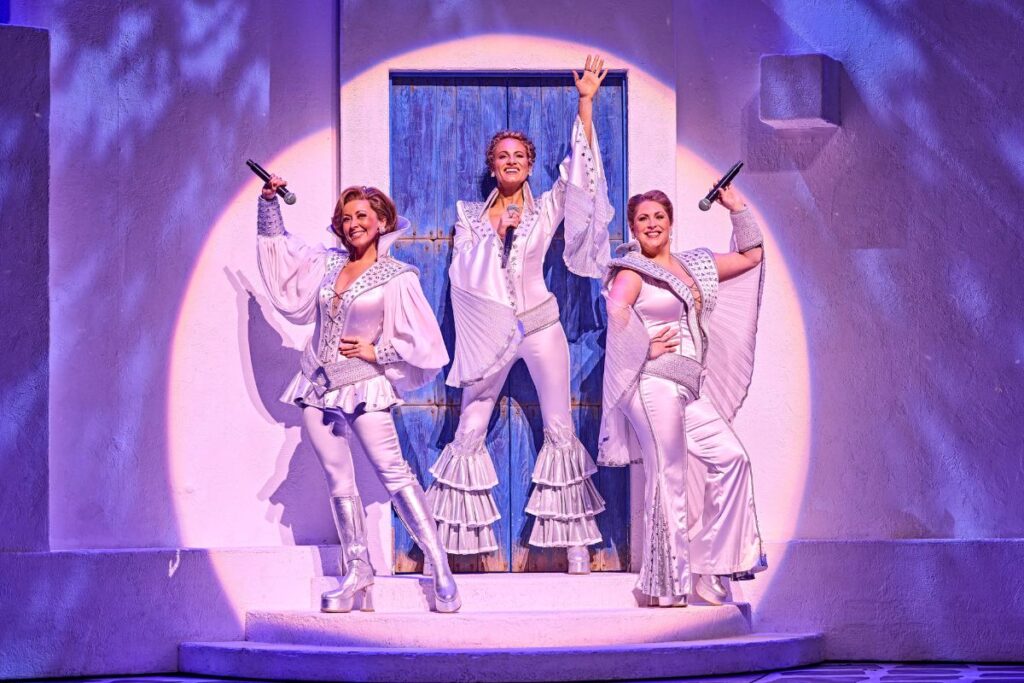
But when MAMMA MIA! comes to Leeds Grand Theatre, there will be one extra local reason to pay attention. Playing Tanya, one third of Donna and the Dynamos, is Leeds-born performer Sarah Earnshaw.
For Earnshaw, whose extensive stage career includes Wicked, Spamalot, Nativity! The Musical, Some Mothers Do ’Ave ’Em and now several years with MAMMA MIA!, returning to Leeds is not just another date on the tour schedule.
“It’s quite emotional in a lot of ways,” she says. “You don’t ever really know going into this as a profession whether you’re actually going to succeed. So when you come back and you are in something as big as MAMMA MIA!, and you get to do it in your hometown in front of that local crowd, that is really, really lovely.”
“It’s Where It All Began”
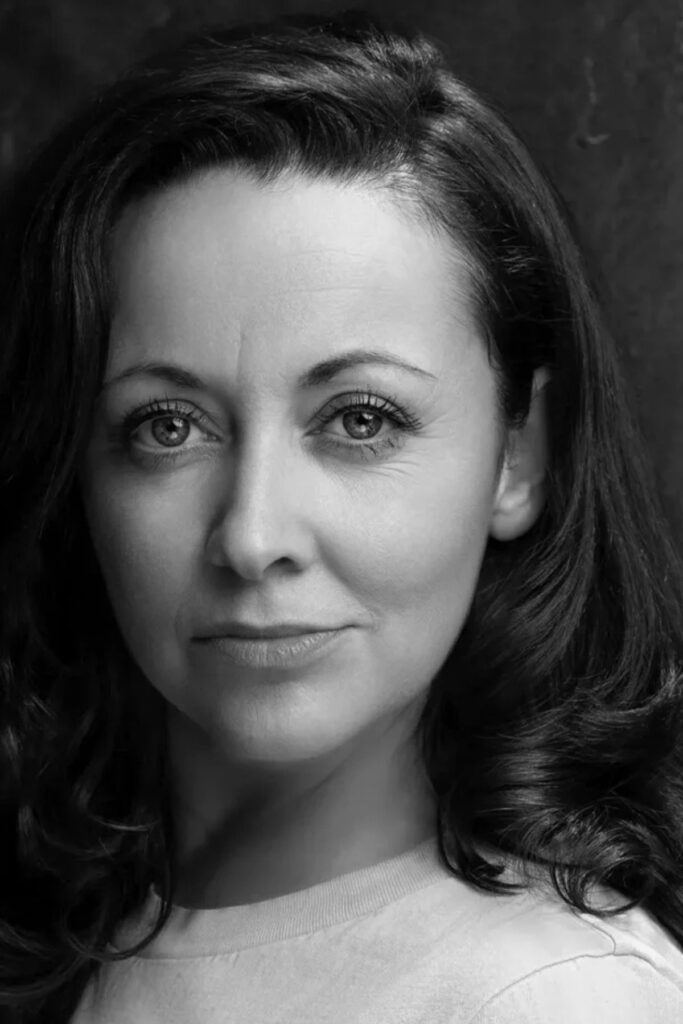
The local crowd matters. And so does the building, as Earnshaw grew up watching touring musicals at Leeds Grand Theatre, sitting in the auditorium and imagining (long before she knew whether it would be possible), that this was what she wanted to do.
“It was those theatres that I grew up watching shows at, particularly the Leeds Grand,” she says. “I’d see the touring musicals that would come up when I was a child and think, ‘Oh my God, this is what I would love to do.’ It’s sort of where it all began, really.”
She also performed as a child in Leeds, including amateur theatre and professional work, and remembers being just six years old doing panto. Later, at around 10, she appeared with the children’s cast in Gypsy at West Yorkshire Playhouse (now called Leeds Playhouse). But the memory that seems to have embedded itself most vividly is watching Blood Brothers at Leeds Grand.
“I remember having my mum buy me the soundtrack,” she says. “At that time, it was, you know, buying CDs, it wasn’t streaming, and absolutely wearing that CD out and knowing all the words inside out and back to front from that experience.”
Now, she returns to the same theatre in a show that has generated its own form of lifelong devotion.
MAMMA MIA! tells the story of Sophie, a young bride-to-be trying to discover the identity of her father before her wedding on a Greek island. Her search brings three men from her mother Donna’s past back into their lives, while Donna’s old friends, Tanya and Rosie, arrive with memories, mischief and emotional reinforcement.
It is funny and famously feel-good, but Earnshaw is quick to point out that the musical works because the story underneath is stronger than people sometimes give it credit for.
Finding Tanya Beneath The Sparkle
For many audience members, Tanya is instantly associated with Christine Baranski’s scene-stealing performance in the films. Earnshaw understands the affection people have for that version, but she is also keen to remind audiences that MAMMA MIA! began life on stage.
“I think a lot of people don’t know that the musical was first,” she says. “It opened in 1999. So it was already a very established character, I think, even before the movie happened.”
She describes Baranski as brilliant, sassy and effervescent, but says the key to playing Tanya is to bring your own style to it.
“I think it is very important that you keep your own style with it. And actually I think in me, there is a little bit of Northern. I don’t do it in a Northern accent, but I think it comes from a place of where I’m from.”
Her Tanya is glamorous and wealthy, yes, but not necessarily born into that world.
“I play Tanya, she’s very wealthy, but I play her as if she’s new money,” she says. “She’s not from that privileged background necessarily that you might believe. I’ve married well.”
That reading gives Tanya a different edge. She is polished, rather than passive and (of course) funny and glamorous, but grounded by something tougher underneath.
“I think what I love about her the most, apart from all of those things which make her so much fun, is that she’s also a fiercely loyal friend,” says Earnshaw. “That is really important to the story.”
For Earnshaw, Tanya is the sort of woman who might be off somewhere dazzling, but will still show up when it matters.
“She’ll be in Monaco doing something glamorous,” she says. “But if somebody calls her, she’ll go. She’ll be there.”
The Women At The Heart Of MAMMA MIA!
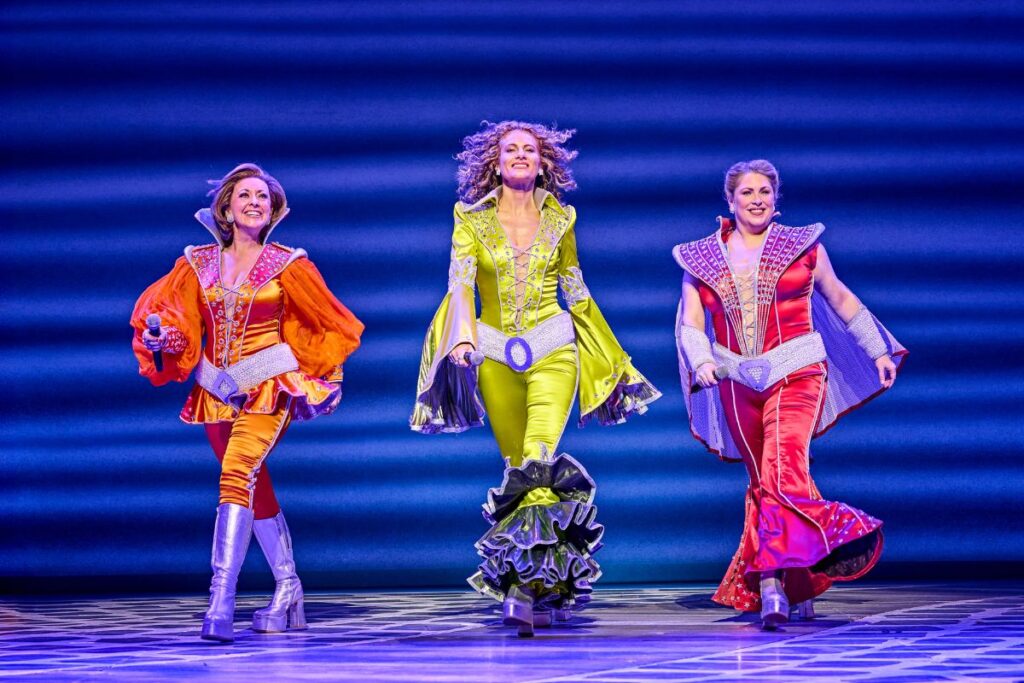
It is easy to talk about MAMMA MIA! in terms of the ABBA catalogue, the sunshine and the finale but Earnshaw keeps returning to the relationships.
“The women in this show are at the forefront of the plot, and we drive it so much,” she says. “It’s so great to have women at the forefront of the musical. I love that.”
At its centre is the friendship between Donna, Tanya and Rosie. They arrive with the jokes and histories that become the shorthand of women who have known each other through different versions of themselves.
“The friendship is at the heart and soul of the show,” says Earnshaw. “When you get women and men, but I think particularly women, coming to see the show, they recognise those strong female friendships.”
She also points to the show’s female creative team as a vital part of why those friendships feel so recognisable. MAMMA MIA! was written by Catherine Johnson, directed by Phyllida Lloyd and produced by Judy Craymer.
“Because the show was created by women, it was directed by a woman, produced by a woman, written by a woman, we can identify with that so brilliantly,” she says. “We all have those female friendships in our lives. Those people you ride or die.”
That, perhaps, is why MAMMA MIA! has never simply been a story about one bride, three possible fathers and a suitcase full of ABBA songs. It is also about the women who gather around each other when life gets messy.
“I Don’t Try And Play Her Older”
For a generation who first watched MAMMA MIA! as teenagers or young adults, there is something quietly fascinating about returning to it in your 40s.
When the show first entered many of our lives, Donna, Tanya and Rosie seemed like the older women. Now, for elder millennials, they are suddenly much closer to our own life stage.
Earnshaw, who is 42, laughs at the shift.
“I was quite young when I first watched MAMMA MIA! as a production, and to me, someone in their mid-40s was much older,” she says. “Whereas now I’m there.”
That has changed her relationship with the role.
“I don’t try and play her older, actually,” she says. “I think my age is about right, from where it should be.”
She thinks the film versions may have slightly altered audience perception of the characters’ ages, but on stage, Tanya makes sense to her as a woman in her early 40s.
“I think now I do have a bit of life experience and I am older myself, I don’t really need to try and force anything else,” she says. “Maybe there’s an expectation that they’re a bit older. But actually, it’s written as early 40s, really.”
There is something really refreshing in that MAMMA MIA! is not a show where women in their 40s are quietly moved to the margins. They are funny, flawed, desired, complicated, ridiculous, emotional and still very much at the heart of the story.
Then, of course, there is the music.
For Earnshaw, Does Your Mother Know is a joy to perform, partly because of where it lands in the show.
“It comes at a perfect time in the story,” she says. “There’s been a little bit of drama and it sort of brings everything to life. It’s light-hearted and it’s fun.”
The staging helps too.
“The dancing that the ensemble do in it is brilliant,” she says. “And I get to stand in the middle and sing and watch them be fantastic.”
She also loves Dancing Queen, especially because of what it says about friendship.
“It’s about that female friendship,” she says. “It’s the two Dynamos rallying around Donna, trying to make her feel better. And we also reprise that in the mega mix, which is iconic. It’s fun. It’s like a pop concert.”
Why MAMMA MIA! Still Works
The mega mix is part of what makes MAMMA MIA! unlike most nights at the theatre. By the end, the audience is not just watching. They are participating in the release.
“We love it,” says Earnshaw. “We feel better when we come off after that bigger mix than when we first started the show. It gets all your worries away. I think it’s the same for the audience and the same for us.”
Earnshaw has travelled internationally with MAMMA MIA!, performing the show across Asia, China, India, Europe and beyond. Wherever it goes, she says, the reaction at the end is universal.
“They’re all on their feet at the end,” she says. “That never changes.”
The humour, though, lands in different ways. “I think the Brits are more keyed in with the humour,” she says. “It was written by a British woman and the humour is British. You’ll get different reactions in different countries because sometimes there are language barriers, sometimes we’ve got subtitles, but they will get it. They always get it.”
The reason it endures, she says, is partly ABBA. But not only ABBA.
“It’s the music of ABBA firstly,” she says. “People love it. It’s timeless. You don’t get to see ABBA in concert anymore, so this is something you can see if you’re an ABBA fan.”
But the show’s emotional structure is what has kept audiences coming back.
“The story is brilliant,” she says. “The songs are interwoven perfectly. The characters are strong. You can go and see and identify with somebody in there. The friendships, the love, the mother and daughter relationship, generational love, friendship love, romantic love, all of that. It’s all in there.”
Despite having performed the show for years, Earnshaw still feels nerves on particular nights. Friends and family in the audience can do it. Major anniversary performances can do it. She remembers the 20th anniversary of the tour in Dublin, performed in a huge arena with original creatives and long-standing team members watching from the audience.
“That’s terrifying,” she says. “All the people that really know what they’re talking about are all watching at the same time.”
Day to day, though, the nerves have softened into experience. A show day is a mixture of discipline, voice care, energy management and the occasional attempt at the gym.
“I might go to the gym if I’m being good,” she says, laughing. “I’m not always good, but I’ll try.”
A one-show day allows for a little more breathing space. A two-show day, she says, is “straight into work, really.” Warm-up starts at the theatre, followed by a fast turnaround into hair, make-up and costume.
“You’ve got to look after your voice,” she says. “You’ve got to make sure that it isn’t overused in the day.”
After a career that has taken her from West End musicals to comedy, pantomime, concerts and television, Earnshaw is clear about what she would say to young performers starting out now, particularly those from the North.
“You have to watch so much stuff,” she says. “Watch the good and the bad and see everything you possibly can. Be as involved as you can, whether that’s in lessons or groups or amateur theatre.”
She also believes the industry has shifted in its attitude towards regional accents and backgrounds, though not without challenges.
“At one point, they didn’t want people with certain accents. They wanted you to be more neutral,” she says. “But I think they’re really embracing authenticity and their own regional accents and their own backgrounds. I think that is brilliant, and we need that.”
For all the glamour of MAMMA MIA!, Earnshaw’s own relationship with Leeds remains grounded. When she gets a little time back in the city, she plans to head to Leeds institution Bibis Restaurant Leeds with family.
“It’s brilliant,” she says.
And Leeds Grand itself? No convincing needed.
“The Leeds Grand is actually one of my favourite theatres in the UK,” she says. “The auditorium is just sensational. It’s so beautiful. I’ve been lucky enough to have played a lot of theatres now in the UK and in many other countries as well, and it is one of my favourites.”
That affection should matter to Leeds audiences as this is not just a touring performer arriving in a city. This is someone coming back to the theatre that helped shape her imagination, in a musical that continues to delight audiences.
So what does she hope Leeds audiences feel when they leave?
“I just hope that they have a brilliant night out,” she says. “It’s as simple as that. I hope they laugh, I hope they have a little cry, a little tear, maybe a move at some point, but mainly that they leave uplifted and feeling better than when they walked through the door.”
And if she had to finish the sentence, “For me, MAMMA MIA! is…”?
Her answer is instant.
“Joy.”
MAMMA MIA! runs at Leeds Grand Theatre from Tuesday 16th June to Saturday 27th June 2026.
Tickets are available from £66 to £36 via Leeds Heritage Theatres: https://leedsheritagetheatres.com/whats-on/mamma-mia-2026/
Review by Victoria Reddington @vic_reddington
Images supplied