Most trading and DeFi teams start on shared RPC and stay there too long. By the time they notice missed fills or broken dashboards, the infrastructure debt is already expensive. For Solana-based projects, moving to a purpose-built Solana dedicated node is often the moment when reliability and performance stop being a guess.
The core issue is simple: Solana is fast, but not forgiving. When markets spike, a generic shared endpoint tends to show its limits first. Latency jumps, rate limits hit at random, and “occasional” dropped WebSocket streams start to hide real money problems.
Solana RPC SaaS tools, such as those from RPC Fast, grew out of this exact pain. After supporting dozens of HFT teams and DeFi platforms, the pattern repeats: once order flow, liquidations, or arbitrage strategies reach a certain scale, “good enough” RPC stops being good enough.
What changes when you treat RPC as a product, not a utility

Many teams think of RPC as plumbing—something you set once and ignore. On Solana, it behaves more like an execution surface. A serious RPC SaaS setup brings three shifts:
- From flat endpoints to tiered plans
Instead of a single, opaque URL, you receive plans mapped to real workloads: testing, early production, streaming-heavy apps, and full HFT setups. That includes JSON-RPC, WebSocket, and gRPC streaming options sized to your profile.
- From best-effort to measurable performance
Latency, error rates, and dropped subscriptions become visible in dashboards rather than remaining anecdotal. You see how your apps behave during periods of volatility, not just on quiet days.
- From “hope it lands” to delivery-aware routing
With features like Solana’s Stake-Weighted QoS (SWQoS) and peering through partners such as bloXroute, the focus shifts to the probability that your transaction reaches the leader at all, not only the priority fee you attach.
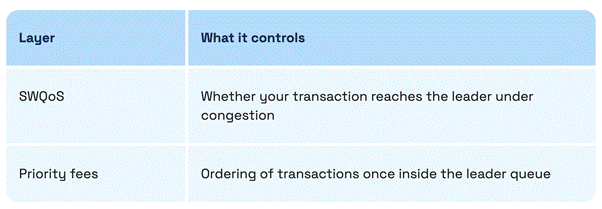
In practice, that means fewer invisible execution losses. The trade-off is clear: a bit more effort upfront in selection and integration, in exchange for predictable behavior when the network is crowded.
RPC SaaS vs a single shared endpoint: What business leaders should watch
From a business point of view, RPC choices translate into three levers: cost predictability, execution quality, and operational risk.
- Cost structure
Shared RPC often looks cheap until bandwidth, add-on streaming, or overage fees appear under load. More mature Solana RPC SaaS offerings simplify this:
- Compute-unit-based billing instead of per-GB bandwidth;
- Included JSON-RPC, WebSocket, and, in higher tiers, Yellowstone gRPC and Shredstream;
- Clear pricing for heavy methods such as getProgramAccounts, which are essential for indexers and DeFi analytics.
Finance leads care about this because it turns “RPC surprise” into a known line item that scales with real usage.
- Execution quality and fairness
On Solana, the order in which transactions hit the leader decides who captures arbitrage, avoids liquidation, or executes a strategy on time. Two factors matter here:
- Visibility during propagation: Shred-level streams let teams see transactions while they travel through the network, not only after blocks are built.
- Delivery probability under congestion: SWQoS and dedicated peering raise the odds that your transactions arrive when the network is hot, instead of being silently throttled.
For trading and DeFi, both have a direct P&L impact.
- Operational risk and incident load
Every fast-growing Web3 team has had the “RPC is down, who owns this?” incident. A structured Solana RPC SaaS setup usually reduces:
- Unplanned firefighting by in-house engineers;
- Time to diagnose whether a problem is on-chain, in the RPC layer, or in application logic;
- Vendor lock-in, thanks to documented endpoints and migration paths.
This is why more HFT and DeFi teams either start on SaaS or pair it with a dedicated Solana node as they grow.
When a dedicated Solana node becomes the next step

For some teams, SaaS alone is enough. For others, growth forces the question: Is it time for a dedicated node or cluster? Signals you are reaching that stage:
- Frequent rate-limit encounters even on higher SaaS tiers;
- Heavy use of complex RPC calls and continuous streaming for analytics or indexing;
- Strategies sensitive to small latency shifts during market spikes;
- Regulatory or compliance needs that require stronger isolation and custom SLAs.
A dedicated Solana node solution lets you keep the advantages of managed infrastructure while reserving resources and tuning for your workload alone. Vendors such as RPC Fast base their dedicated offerings on the same stack as their SaaS, which simplifies migration: you keep patterns and tooling, while gaining control over topology, geo-distribution, and failover.
For leadership, this is less about infrastructure pride and more about risk. The question becomes: at what volume of trades or assets under management does it make sense to move from shared limits to guaranteed capacity?
Images courtesy of unsplash.com, Freepix.com and pexels.com